NEW
2025 Annual Report: at NEIKER, we continue to generate knowledge and provide solutions to the sector
30 April 2026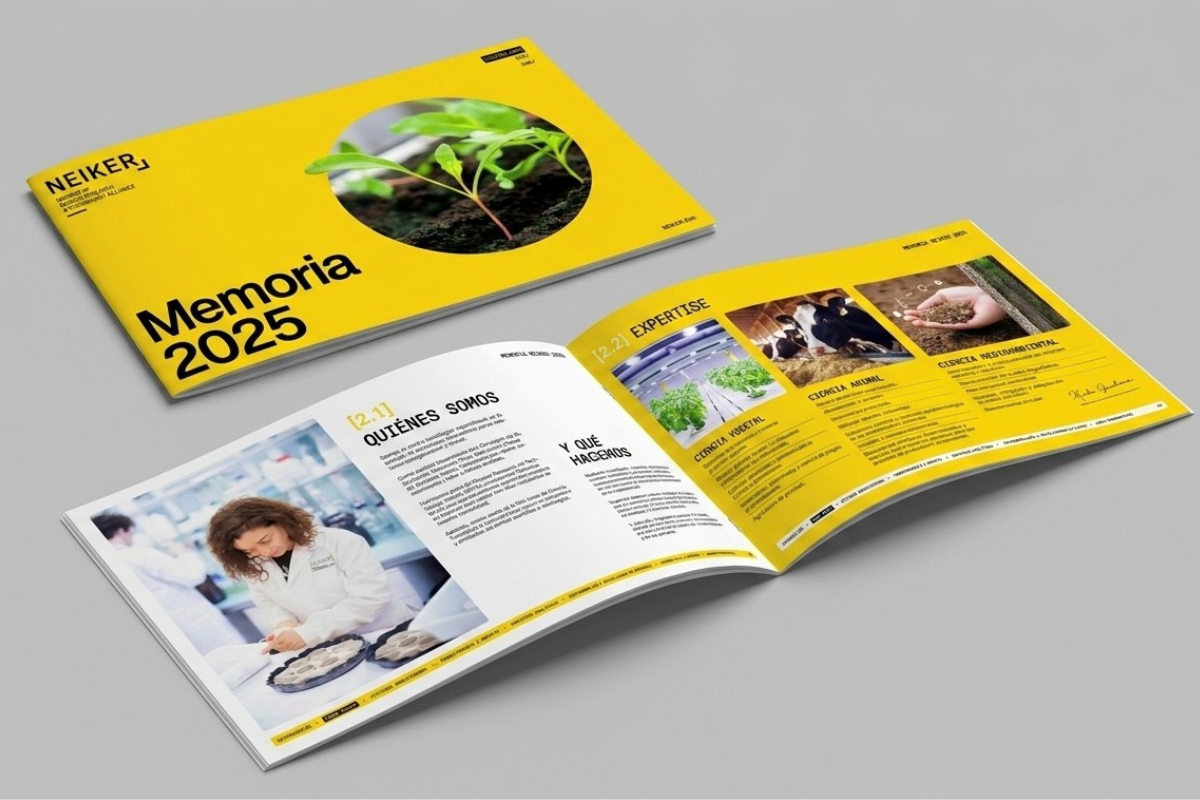
In 2025, at NEIKER we have continued to move forward with determination in our commitment to generating useful knowledge and transferring it to the agricultural, livestock and forestry sectors, contributing to their sustainability and competitiveness through applied R&D&I.
One of the most significant milestones has been the launch of the Berritzen Plan, designed to further align innovation with the sector’s real needs. It includes experimental demonstration plots, the transfer of results, and an open channel for gathering ideas from the sector itself.
Within Berritzen, in 2025 we have worked closely with the wine sector on precision viticulture projects to optimise vineyard management, promoted the recovery and conservation of plant material from minority varieties as a strategy to tackle climate change, and are promoting management practices that improve the resilience of crops to extreme weather conditions.
Read the annual report
Renovation of key infrastructure
Over the past financial year, we have also made a significant effort to strengthen our scientific infrastructure in order to remain at the forefront of research, representing an investment of €4,200,000.
A key highlight is the refurbishment of our BSL3 maximum-security laboratory in Derio, which is essential for work on the One Health approach and for research into animal and plant health.
We now have 900 square metres of biocontainment space in Derio, divided into five laboratories, an animal facility with four rooms for small species, four pens for large animals, a post-mortem room and technical areas.
Although we have had BSL3 facilities since 2002, which were originally built to address the diagnosis of mad cow disease (bovine spongiform encephalopathy), it was necessary to upgrade them to improve biosafety standards and thus continue working on research areas such as animal tuberculosis, avian influenza, Q fever and Xylella fastidiosa with the highest level of assurance.
Complementing this commitment to state-of-the-art facilities is the launch in Arkaute of Spain’s largest experimental agrovoltaic unit for arable crops, designed to study the compatibility between agricultural production and renewable energy generation. It consists of 212 photovoltaic modules spread over 8,000 m² and is estimated to generate 163,914 kWh annually, equivalent to the average electricity consumption of around 50 homes.
The contribution of advanced technology
At the same time, we continue to promote agritech solutions for more efficient and sustainable agriculture, and to participate in R&D&I projects with national and international partners, thereby reinforcing our role as a driving force for innovation.
We have launched kABE, a digital platform to optimise livestock management in real time. We are also studying the use of smart collars to monitor and record livestock activity in real time and improve grazing control. As part of our high-tech implementation, we have installed virtual weather stations to optimise water use in agriculture and detect disease risks in arable crops.
Furthermore, we are using drones to promote safer and more sustainable agriculture in trials on arable crops in the Basque Country. These trials will enable us to assess the efficacy and safety of applying plant protection products via drones compared to other ground-based and aerial application methods. The aim is to generate robust scientific data to help validate this technology within the framework of European regulations.
Knowledge transfer events
In line with our commitment to knowledge transfer to the sector, we have organised around twenty workshops and field visits. These are essential not only to ensure that what NEIKER learns reaches the sector as quickly as possible, but also to meet the professionals for whom our work is intended, hear their concerns first-hand, and receive their input so that we can incorporate it into our work.
In 2025, we held events on topics of pressing concern to the sector, such as the measures needed to enable farms to reduce their carbon emissions, the digitalisation of livestock farming, soil protection, reducing the use of plant protection products for disease control, and the transition to organic farming.
All this and much more can be found in our 2025 corporate report. We invite you to read it.