


NEW
NEIKER presents the new guide for local councils on the prevention and control of the tiger mosquito
11 June 2026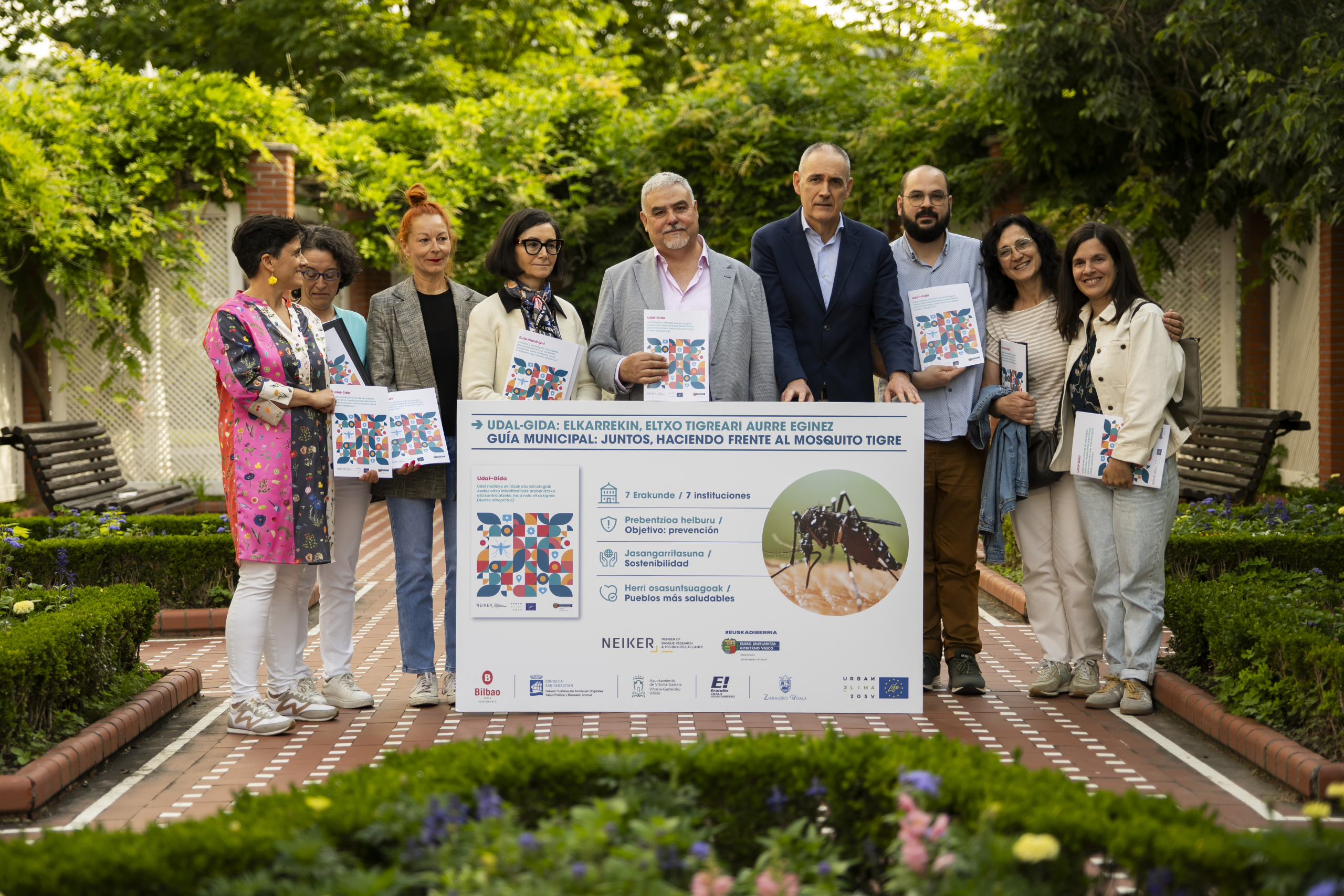
- The document, drawn up by the Department of Health and the NEIKER technology centre in collaboration with several Basque local councils, is designed as a ‘toolkit’ for local action, focusing on prevention, surveillance and awareness-raising, and promoting a coordinated, effective response based on technical expertise
- The Basque Country has now launched the 2026 Surveillance Programme for the Detection of the Tiger Mosquito and is stepping up prevention efforts against this invasive species with measures in around 50 municipalities
- Monitoring is carried out through sampling, with the mosquito already detected in 72 municipalities. Public cooperation and the work of municipal services are key to preventing its spread, by eliminating potential breeding sites and preventing the accumulation of water
The Basque Government’s Department of Health, the NEIKER technology centre and Bilbao City Council today presented in Bilbao the new municipal guide for the prevention and control of invasive mosquitoes of the Aedes genus, such as the tiger mosquito (Aedes albopictus), a key tool for strengthening the institutional response to this growing public health challenge.
The event was attended by the Director of Public Health and Addictions at the Basque Government’s Department of Health, Guillermo Herrero; the Scientific Director of NEIKER, Joseba Garrido; and the Director of Health and Consumer Affairs at Bilbao City Council, Ana Collia, alongside technical staff from the three organisations involved in drafting the document.
The guide aims to provide local councils with practical, flexible and adaptable tools to prevent the spread of the tiger mosquito and reduce the risk of disease transmission, such as dengue, Zika and chikungunya. The document, produced by the Department of Health and NEIKER, in collaboration with the councils of Bilbao, Donostia/San Sebastián, Vitoria-Gasteiz, Erandio and Zarautz, and within the framework of the European LIFE IP Urban Klima 2050 project, proposes a progressive approach—basic, intermediate and advanced—and is designed as a ‘toolkit’ for local authority action, focused on prevention, surveillance and awareness-raising. Its aim is to promote a coordinated, effective response based on technical knowledge, in which the involvement of local authorities and the public is essential.
The tiger mosquito poses a public health challenge that requires a comprehensive approach based on the ‘One Health’ framework, in line with the provisions of the Basque Health Pact, which recognises the close relationship between human health, environmental health and the effects of climate change. The spread of vectors such as the tiger mosquito is a clear example of this interconnection.
“Anticipate and eliminate breeding grounds”
During his speech, Guillermo Herrero, Director of Public Health and Addictions at the Basque Government’s Department of Health, emphasised the importance of prevention: “Controlling the tiger mosquito is key to preventing the transmission of viral diseases such as dengue, Zika and chikungunya. The best preventive strategy is to be proactive and avoid the conditions that favour their reproduction.” In this regard, he highlighted the essential role of local councils: “If we want to stop transmission, we must take action in the areas where the mosquito finds conditions conducive to its development. Local council involvement is one of the most effective measures for protecting public health.”
For his part, Joseba Garrido, scientific director of NEIKER, highlighted the importance of a multidisciplinary approach and the role of science and research in resolving issues that affect the public. “This guide is the result of collaboration between various departments of the Basque Government and several local councils, which have joined forces to develop a tool aimed at both institutions and society.” He also noted that “it forms part of an ongoing collaboration between NEIKER, the Department of Health and other bodies, through which we jointly tackle challenges such as zoonotic diseases, antimicrobial resistance and other health challenges using a ‘One Health’ approach.”
For her part, Ana Collía, Director of Health and Consumer Affairs at Bilbao City Council, emphasised the importance of tackling the issue in a cross-cutting manner by providing a joint response, including at the municipal level. “Coordinated management between the various departments involved is essential at the municipal level, through a Comprehensive Municipal Vector Control Plan,” she stated.
Following the launch of the guide at Dario Regoyos Park in Bilbao, municipal experts gave a practical demonstration of prevention, monitoring and control tools, such as inspections, traps and sampling techniques. This was followed by a workshop aimed at technical staff from local councils, with the aim of exploring the guide’s content in greater depth and facilitating its implementation at local level.
Launch of the 2026 Monitoring Programme
Along with the presentation of the guide, the Department of Health has announced the launch of the Surveillance Programme for the Detection of the Tiger Mosquito in the Basque Country, which this year will cover around 50 municipalities: 15 in Álava, 19 in Bizkaia, and 16 in Gipuzkoa. Surveillance will begin on 15 June and will run until mid-autumn, covering the period of peak activity for the tiger mosquito.
The programme, which has been running since 2013, is based on a system of trap sampling in urban and peri-urban areas, which makes it possible to monitor the presence and distribution of the mosquito and assess the risk in each region. To date, the Asian tiger mosquito has been detected in 72 Basque municipalities, particularly in densely populated urban areas, reinforcing the need for active and sustained surveillance. Hence the importance of the municipal guide presented today, a tool designed to facilitate the prevention and control of this species.
Prevention is key to halting its spread
La colaboración ciudadana, junto con la labor de los servicios municipales, es clave para frenar la expansión del mosquito tigre, principalmente adoptando medidas que impidan su reproducción. Los mosquitos necesitan pequeñas cantidades de agua para la puesta de huevos, por ello, lo más efectivo es eliminar esos posibles focos de cría, evitando acumulaciones de agua en nuestros hogares y zonas urbanas.
Public cooperation, alongside the work of municipal services, is key to halting the spread of the tiger mosquito, primarily by taking measures to prevent it from breeding. Mosquitoes need only small amounts of water to lay their eggs; therefore, the most effective approach is to eliminate these potential breeding sites by preventing water from accumulating in our homes and urban areas.
- Prevent water from collecting in containers, gutters, drains or sewers
- Empty plant pot saucers, buckets, toys and water containers twice a week
- Keep containers that hold water covered
- Change the water in animal drinking troughs frequently
- Use mosquito nets on windows and water containers
It is also recommended that particular attention be paid to areas such as allotments and cemeteries, where water can accumulate more easily. Members of the public can also help to identify them by using the Mosquito Alert app, which allows users to geolocate and report the presence of the insect: https://www.mosquitoalert.com
What to do if you are stung
This mosquito, which is small and black (around 5 mm in size) and recognisable by a white stripe on its head and thorax, is active during the day, so it usually bites during daylight hours. It is also common for it to bite several times in quick succession. Tiger mosquito bites can be more painful and cause a severe reaction; therefore, it is recommended to clean the area with soap and water and apply a cold compress to reduce swelling and relieve the itching. Furthermore, you should not scratch the area to prevent infection. If the reaction is very severe and causes discomfort or even breathing difficulties, you should consult a healthcare professional.
Meanwhile, anyone who has travelled to a risk area should take extra precautions to avoid mosquito bites for the 15 days following their return. If, in addition, they develop symptoms (mainly fever, signs of pain, discomfort, etc.), they should consult their local health centre immediately. This invasive species is capable of transmitting diseases such as dengue, Zika and chikungunya; although the likelihood of infection in the Basque Country is very low, no indigenous cases have been detected.
Further information on the tiger mosquito, prevention measures and the surveillance programme is available on the Department of Health’s website: https://www.euskadi.eus/informacion/mosquito-tigre-aedes-albopictus/web01-a2ingsan/es/