NEW
Seeds that tell a story: NEIKER’s Germplasm Bank, guardian of Basque rural heritage
16 December 2025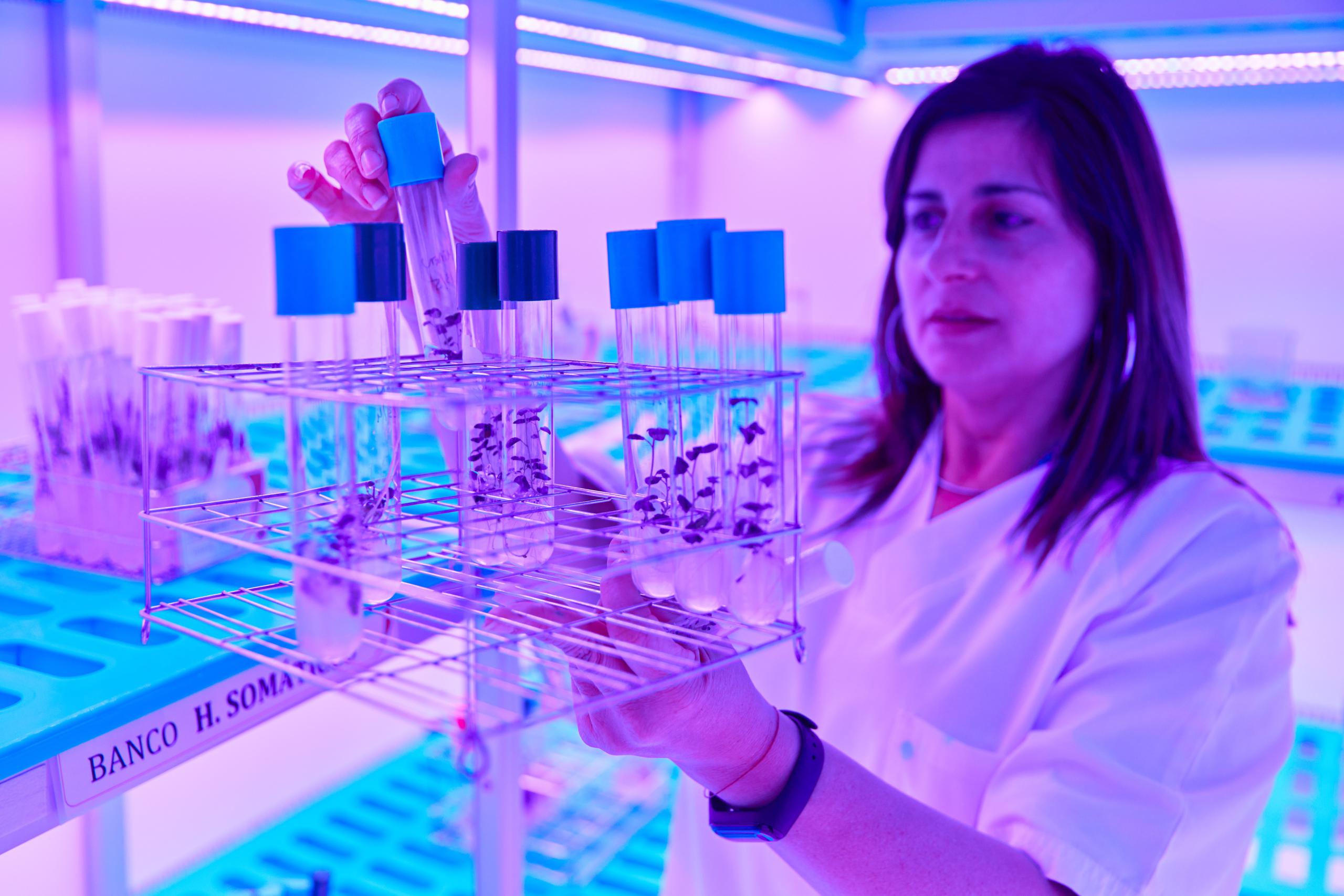
- The NEIKER Germplasm Bank has a total of 865 varieties from its collections of potatoes, maize, beans, tomatoes, peppers, chillies, cereals and apples.
A genetic archive is vital in the face of change and agricultural homogenisation. Genetic diversity in agriculture is, quite simply, life insurance for the future. Faced with the threat of climate change, the emergence of new pests and the homogenisation of crops on a global scale, the adaptability of our food system is becoming critical. Protecting agricultural biodiversity is essential for food sovereignty and the improvement of future crops. The Food and Agriculture Organisation of the United Nations (FAO) has warned that the loss of genetic variability—a process that has seen the disappearance of nearly 75% of cultivated varieties in the last century—jeopardises food availability in the face of new pests and diseases.
In this context of global fragility, the NEIKER Germplasm Bank stands as a fundamental facility. More than just a seed repository, it is an active centre for research and preservation, a ‘gene library’ that ensures that the valuable agricultural heritage of the Basque Country and Spain is not lost. Its mission is twofold: to prevent irreparable damage and to provide the genetic raw material necessary for improvement programmes to develop the crops of tomorrow.
The memory of the countryside: collecting and preserving
The work carried out today by NEIKER has its roots in the rural history of the Basque Country. Concern for the conservation of genetic resources began to gain momentum in the 1980s, coinciding with the decline of traditional agriculture. Many of the varieties held in the bank were originally collected by official bodies that travelled from farm to farm, rescuing seeds from farmers. This origin gives the bank incalculable historical and cultural value.
NEIKER (initially under other names) assumed responsibility for collecting, cataloguing, characterising and conserving ancient cultivars, native varieties and wild species of agricultural interest. Conservation is carried out in situ (in the original location, such as farmhouses or the natural environment) and ex situ (at the Bank’s facilities, as seeds, in vitro or living plants). It is not enough to simply collect. Since its formal creation in 1997, the NEIKER team has carried out rigorous work to identify, genetically characterise and eliminate duplicates, ensuring that each entry is a unique and valuable genetic resource. These collections are not just a ‘museum’, but living material for research and genetic improvement, for example, to find traits related to disease resistance. This effort makes the material available to farmers, researchers, and companies seeking both genetic resistance and the recovery of authentic flavours to meet new consumer demands.
The three avenues of conservation
Germplasm conservation requires specialised protocols, as not all plants can be stored in the same way. At NEIKER, various maintenance techniques are used:
Seed bunker
For crops such as maize, beans, and cereals, the standard technique involves cleaning the seeds, drying them to a minimum moisture content, and storing them in airtight containers at low temperatures (the active collection is kept at 4 °C). In the case of horticultural species such as tomatoes, peppers, chard, lettuce, squash and leeks, the seeds are usually stored at 4 °C or frozen at -20 °C after cleaning and drying. In this way, their viability is extended for decades, and they only need to be regenerated in the field periodically. Cold storage of seeds is the most widely used ex situ method.
In vitro cultivation: the exception of the potato
The potato (Solanum tuberosum L.) poses a particular challenge, as it reproduces through vegetative multiplication and its tuber degenerates rapidly, making it impossible to reproduce viably by seed. For this reason, NEIKER resorts to in vitro cultivation. The plants are maintained as small sterile tissues in test tubes in the laboratory, keeping them alive through micropropagation.
This method, which requires constant and rigorous multiplication, guarantees the health of the material. This dedication has positioned NEIKER as the only potato germplasm bank of national reference and one of the most diversified reference banks in Europe.
The living museum: conservation in the field
Certain fruit trees, such as apple trees, are not suitable for cold storage. In these cases, the varieties are preserved through in situ collections, planted in situ, directly in the field. This ‘living museum’ allows their characteristics to be observed in a natural environment and preserves the genetic memory of the rural landscape.
Networks and international collaboration
The NEIKER Germplasm Bank does not work in isolation. It is part of national and European collaboration networks, which enable the exchange of genetic material and vital information. At the national level, NEIKER belongs to the Spanish Network for the Conservation and Use of Plant Genetic Resources (RED-GRAN), coordinated by INIA-CSIC. At the European level, it is also part of The European Cooperative Programme for Plant Genetic Resources (ECPGR), a collaborative programme between countries whose objective is to ensure long-term conservation and facilitate the greater use of plant genetic resources in Europe. In terms of maximum global security, the shipment of seeds to the Svalbard Global Seed Vault is centralised by the INIA-CSIC National Centre for Plant Genetic Resources, which manages all germplasm collections at the state level.
Unique wealth: collections with their own identity
The true value of the bank is measured by the uniqueness of its collections. NEIKER not only accumulates material, but also houses an exceptional set of varieties with high genetic and cultural value, many of which are crucial for maintaining the identity of Basque gastronomy and agricultural resilience.
In the area of tubers, the bank is the national leader in potatoes, serving as the state reference centre. Its collection includes 308 potato varieties and 78 entries of wild species related to the Solanum genus, a genetic treasure trove that is crucial for the search for resistance to new diseases.
As for Basque vegetables, this work is key to safeguarding local cuisine. 154 local varieties of corn are preserved, as well as 128 varieties of beans, including the most emblematic types such as Pinta Alavesa, Gernikesa and Tolosana. In fact, the bank has been instrumental in the implementation of these varieties and improvement programmes associated with products bearing the Eusko Label. The collection is completed with 90 varieties of tomato and 42 varieties of pepper and chilli, which are essential to Basque vegetable gardens.
The field of historical cereals is also fundamental. NEIKER safeguards the only 9 local varieties of oats originating in the Basque Country. Added to this legacy are 14 varieties of barley and 23 varieties of local wheat, an essential genetic heritage for food sovereignty and regional agriculture. Finally, in the field of fruit trees, the collection of native apple trees has enabled the characterisation and official recognition of 19 local varieties, promoting their use in local production, especially in the cider sector.
This treasure held at NEIKER not only looks to the past, but is also the key that unlocks the future of food, providing breeders with the tools they need to face an ever-changing agricultural world.