NEW
NEIKER strengthens its commitment to SALUGANDA Elkartea to promote education, equality and sustainable development in Uganda
12 December 2025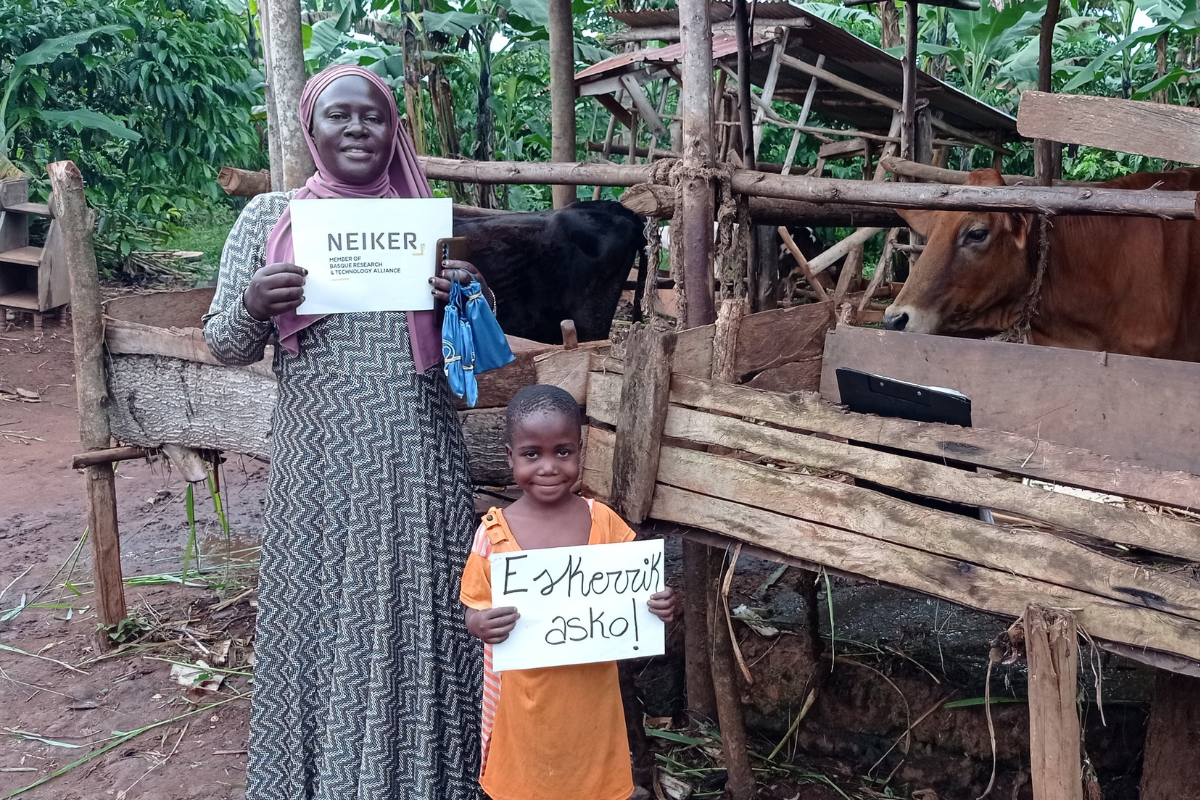
- The collaboration, which has been in place since 2019, now extends to 10 schools where an agro-sustainable cycle based on compost from dry latrines and agricultural facilities has been implemented, improving school gardens.
- This year, the project has reinforced its commitment to education by expanding the scholarship programme and promoting sewing workshops that generate future opportunities for more than 4,300 girls and boys.
NEIKER and the SALUGANDA association continue to improve living conditions in rural areas of Uganda – the districts of Mukono and Buikwe, on the shores of Lake Victoria – where more than 4,300 children from ten schools are currently participating in initiatives that combine infrastructure improvements, agro-environmental education and community development.
The project was born thanks to the initiative of Iker Mijangos, a former NEIKER researcher and current president of SALUGANDA, who during a trip in 2011 decided to apply the knowledge acquired in his doctoral thesis on organic fertiliser to create the first school garden at the Tom and Margaret Carroll Centre orphanage school. “They had a chicken coop, and we thought we could compost the manure with leftovers from the school canteen to fertilise a vegetable garden and thus supplement the pupils’ diet, while also producing corn for the chickens. On my return, I proposed to NEIKER that we expand the project by taking advantage of our knowledge, and they accepted immediately. That’s how we started,” recalls Mijangos. Seeing that the project was growing and new schools were joining, in 2019 they decided to create the SALUGANDA volunteer association and establish a collaboration agreement that has been renewed annually since then.
Basic infrastructure to ensure health and food security
During the early years, the initiative focused on meeting essential needs: dry latrines, drinking water tanks, chicken coops, pig farms, vegetable gardens and facility improvements. This foundation has enabled progress towards a self-sufficient model where schools generate much of their own food and fertiliser using compost and ash from wood-burning stoves.
In recent years, the project has also sought to improve school infrastructure by installing more efficient wood-burning stoves and solar panels to light the new dormitories for orphaned students who live at the schools. Until then, they slept on the floor of the classrooms.
It has also provided equipment that facilitates their autonomy: photocopiers, printers and computers that allow them to produce their own school materials adapted to their level and needs, something that previously they could only buy in the capital at a high cost. ‘They are very grateful for the computers that HAZI donated to us this year,’ says Mijangos.
Technology and resources to improve educational quality
Schools have incorporated equipment that facilitates their autonomy: photocopiers, printers and computers. ‘This allows them to produce their own school materials adapted to their level and needs, something that previously they could only buy in the capital, at a very high cost,’ explains Mijangos.
In addition, NEIKER volunteers, such as Roberto Pérez-Parmo, have provided technical advice to improve soil fertility and optimise school gardens through soil analyses carried out in the centre’s laboratories.
Scholarships for girls with the best academic records
In 2015, the project launched a scholarship system to support children from low-income families and facilitate the continuity of their studies. This initiative has been expanded and currently benefits more than 250 vulnerable households.
In 2024, 15 new scholarships have been added for female students with the best academic results, so that they can access secondary education, a stage that many are unable to pursue due to financial constraints.
‘Without the scholarships, many of these girls would stop studying after finishing primary school and would remain in a situation of economic dependence. We try to give them a real alternative, but our budget is limited,’ explains Mijangos.
Sewing and vocational training to create opportunities
To overcome these economic limitations, one of the most notable developments in the last two years is the Skills Training programme, based on sewing training so that students can learn a trade and sell handicrafts to pay for their own studies.
The schools now have sewing machines and specialised teachers who guide the creation of bags, wallets and textile accessories. Some of these items are sold at charity markets in the Basque Country — such as the one taking place on 16 December at NEIKER — and all proceeds go back to the schools.
In addition, NEIKER employees such as Patricia Gallejones and Leire Larreta volunteer their time to make bags, hair ties and other items from fabrics brought from Uganda, which will also be available at the charity market in December.
Women’s sport and gender equality
Across the board, the programme has strengthened the promotion of women’s school sport through the donation of equipment by clubs such as Athletic Club, Real Sociedad, Alavés, Mungia, Iturrigorri, Danok Bat and Sanduzelai. Inter-school football and netball tournaments seek to normalise girls’ participation in sport and promote their empowerment.
The knowledge acquired in sewing classes now also allows them to ‘make their own reusable sanitary pads and not miss days of school, as was the case every month for those in seventh grade,’ concludes Mijangos.
Volunteering and involvement of NEIKER staff
The relationship between NEIKER and SALUGANDA is based both on the institutional agreement and on the direct involvement of the centre’s staff.
Currently, 10 of the association’s 39 members belong to NEIKER. In addition to financial contributions, many collaborate on a voluntary basis in communication activities, markets, technical analyses and educational workshops.
Finally, NEIKER volunteers such as Roberto Pérez-Parmo have travelled to Uganda to provide technical advice on improving soil fertility and optimising school gardens through soil analyses carried out in the centre’s laboratories. Or June Hidalgo, who recently visited our schools to document and communicate progress on social media, as well as collaborating in the annual exchange of letters in English between schools in Uganda and the Basque Country.
Every year, NEIKER’s headquarters hosts an open day where the progress of the project is presented and staff are invited to learn about new ways to get involved.
Coffee and charity market
On 16 December, at 11:45 a.m., as a prelude to the Christmas lunch for public companies in the agricultural and livestock sector, the SALUGANDA project will offer a Charity Coffee at the TOPAGUNE in Arkaute.
Following the experience in January 2025, everyone who comes will be invited to enjoy a Ugandan coffee or tea, while the latest developments in the project are shared and the options for collaboration are explained for those who wish to get involved.
On the same day, there will also be a charity market where it will be possible to purchase products made by children and teachers from Ugandan schools as part of the Skills Training programme, as well as items made by NEIKER colleagues using fabrics brought from the African country. All proceeds will go towards supporting the project’s activities in Uganda.